Author of this article: Andreas Soller
Impact Mapping
Impact mapping is a strategic planning technique used in product development, project management, and agile environments to ensure that teams focus on outcomes, not just outputs. It connects business goals, actors, desired impacts, and deliverables in a visual, mind‑map‑like structure.
7 min read (1486 words)
Impact Mapping
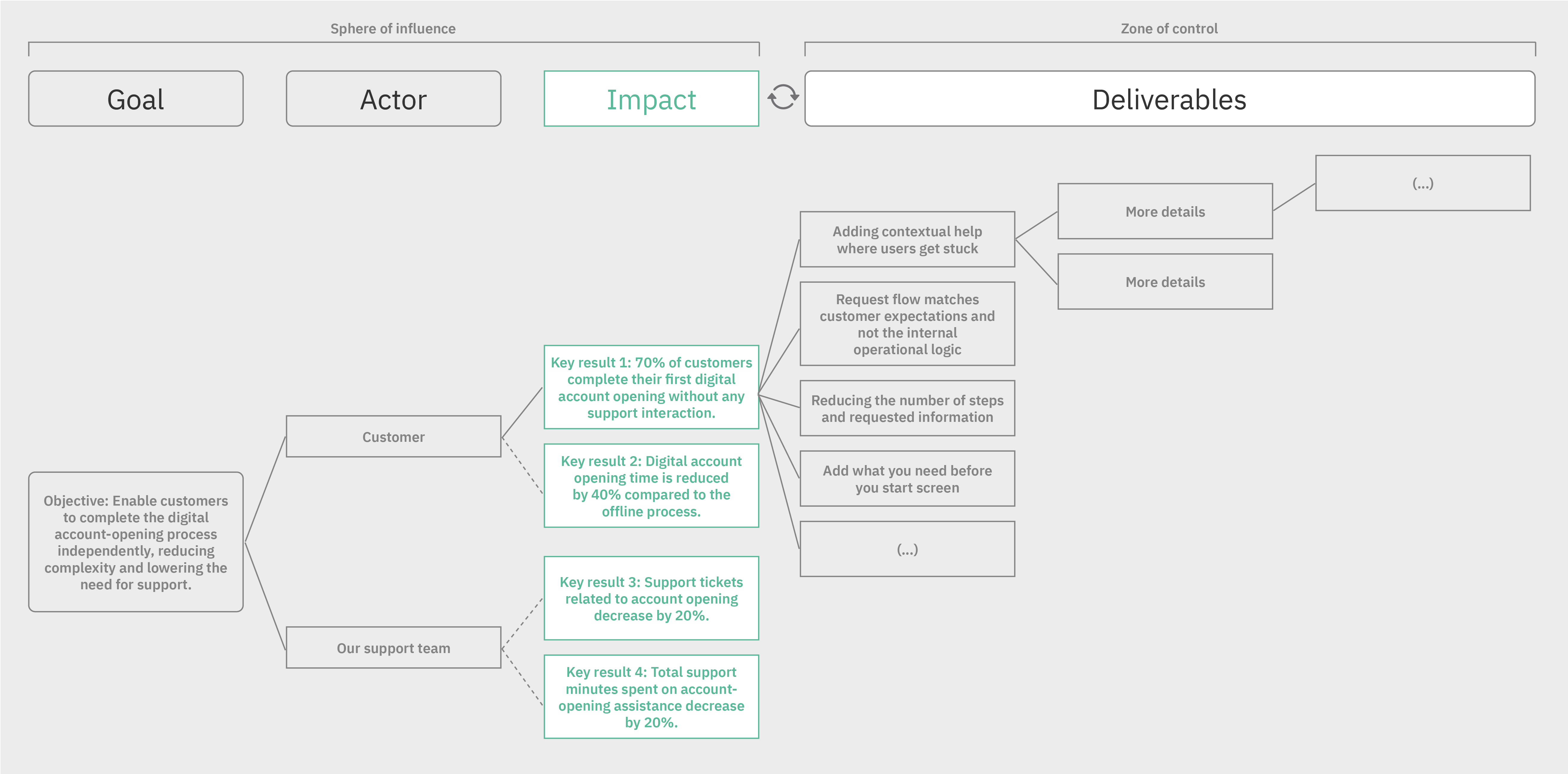
What is Impact Mapping?
Impact Mapping is a mindmapping technique that was developed by Gojko Adzic in 2012 based on the InUse effect mapping.
The map is structured in two parts:
- Sphere of influence: what we want to achieve
- Zone of control: what we can actually do
Sphere of Influence
As part of the sphere of influence you define the business target and the impact (outcome) this target will have on actors (users). From a problem statement perspective you define an actionable problem, the users that are affected by this problem and how solving the problem will change the user behavior.
Zone of Control
The most relevant part of this first analysis is to identify measurable changes in user behavior. This is the starting point for the zone of control: you start creating a map of deliverables (concrete actions, stories, etc.) – something you can do – to make this changes in user behavior happen.
This is the essence of Impact Mapping – a continuous feedback loop between outcome metrics and deliverables:

Outcome-driven development
Connecting measurable outcomes with deliverables shifts the focus away from story points as measure for success and ties deliverables directly with measurable user behavior to continuously monitor if our effort was well spent.
Adzic provides the following metaphor: If you think about a road map there are always many ways to reach a certain destination. When you take a wrong turn, the road map will provide the means to find a new way to the destination or a GPS system will recalculate the way. The outcome metrics are the calibration tool that help to find the right direction again (Cf. Adzic 2016).
Test-driven approach
Deliverables are the next best test
Of course, not only deliverables might take the wrong turn but also business assumptions can be wrong no matter how well they are defined.
Deliverables are any actions taken to achieve the goal. This also includes building confidence – discovery work and research. The flight level of the deliverables depends on the confidence level and knowledge you have about the problem and the users. Continuous validation is not only measuring delivery against measurable outcomes but also re-challenging the goals with every iteration that doesn’t create the expected results.
Underpants Gnome scheme
A word of warning: As the Impact Mapping framework is extremely simple to use, people tend to apply short cuts. Therefore, it is very easy to rush through high level business goals or through completely invented actor-impact relations that render the whole mapping activity meaningless. The worst mistake is to ignore the true power of Impact Mapping and just create a map without doing the continuous validation with outcome metrics. It is not the mapping that guarantees success, it’s how you measure success and integrate validation cycles in delivery that make a difference. Otherwise it will result in the same sunk costs as any other Underpants Gnome scheme.
Takeaway
With Impact Mapping, outcome metrics and deliverables are tied together in a loop. Every delivery is monitored against measurable outcomes to make sure we are on the right track or take the appropriate course corrections.
Sphere of influence
Goal – Actor – Impact
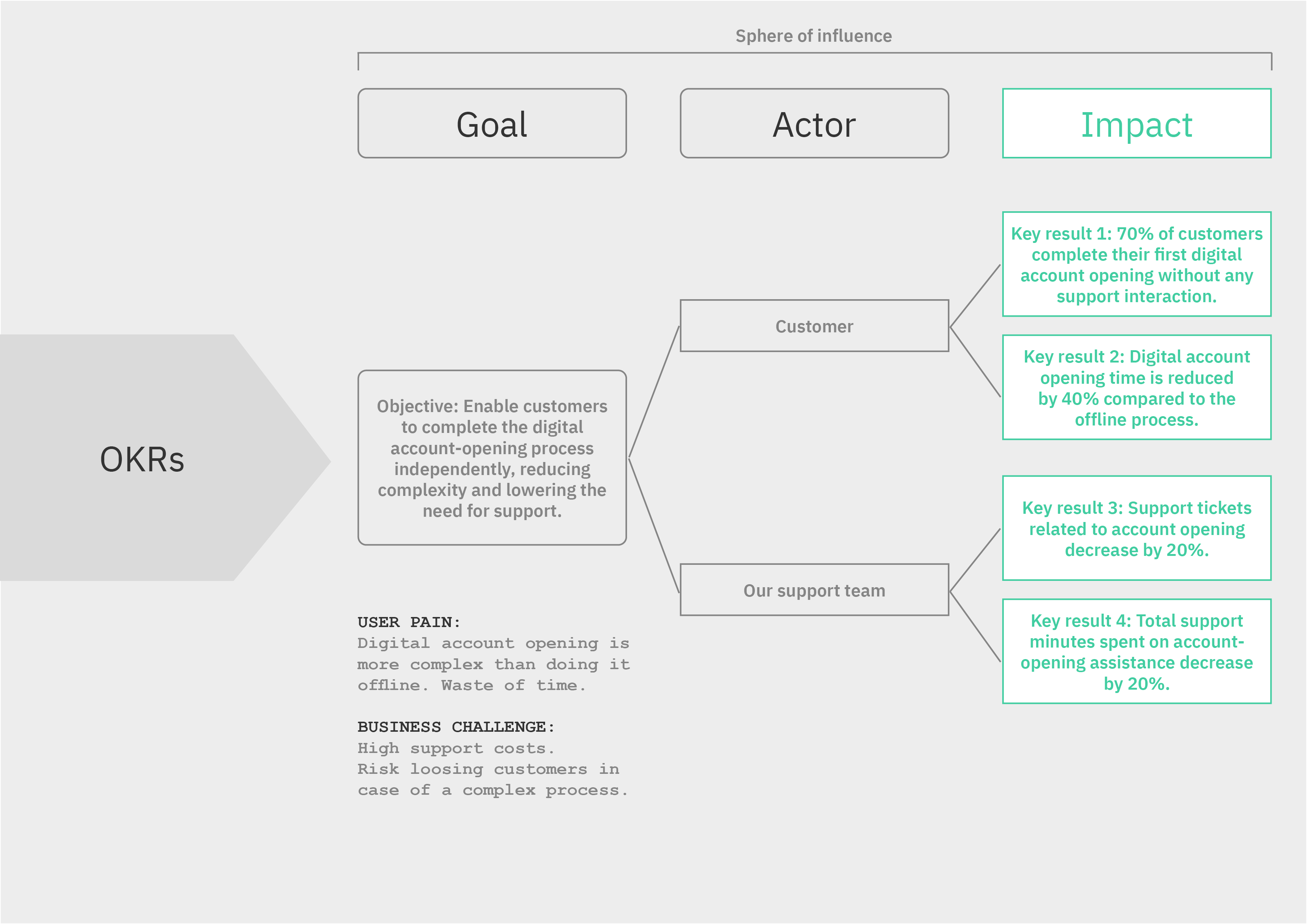
The first step is to understand the user / business goal we want to achieve and what measurable impact achieving this goal will have on actor / user behavior.
Sphere of influence
Configure columns
No results found |
Facilitation
Create a separate Impact Map for each goal. If a clear goal statement is missing, start by exploring suggested features:
Round 1: Understand underlying assumptions
- For whom is this feature relevant / useful?
- What changes in behavior will this feature trigger?
- How do these changes contribute to the business goal?
- Who might hinder or block achieving this goal?
- Who else might be affected by this goal?
- (If you want to include competition probe also for existing solutions on the market and how your solution will differ)
Round 2: Metrics
- If we assume (changes in behavior), how can we measure success (or failure)?
Example
Configure columns
No results found |
To make it easier to phrase measurable outcomes you can use Objectives and Key Results (OKRs). OKRs express what an organization wants to achieve, its direction of change, followed by quantifiable metrics that help to measure if the objectives have been achieved or not.

Sounds familiar?
Usually, you will already have collected this information. People often use the Business Model Canvas for an initial analysis of new business ideas or you will have started with an Opportunity Canvas to explore discovered user problems. Impact Mapping is not replacing any other frameworks. It’s power is its simplicity and how you can integrate it with many other frameworks.
Zone of control
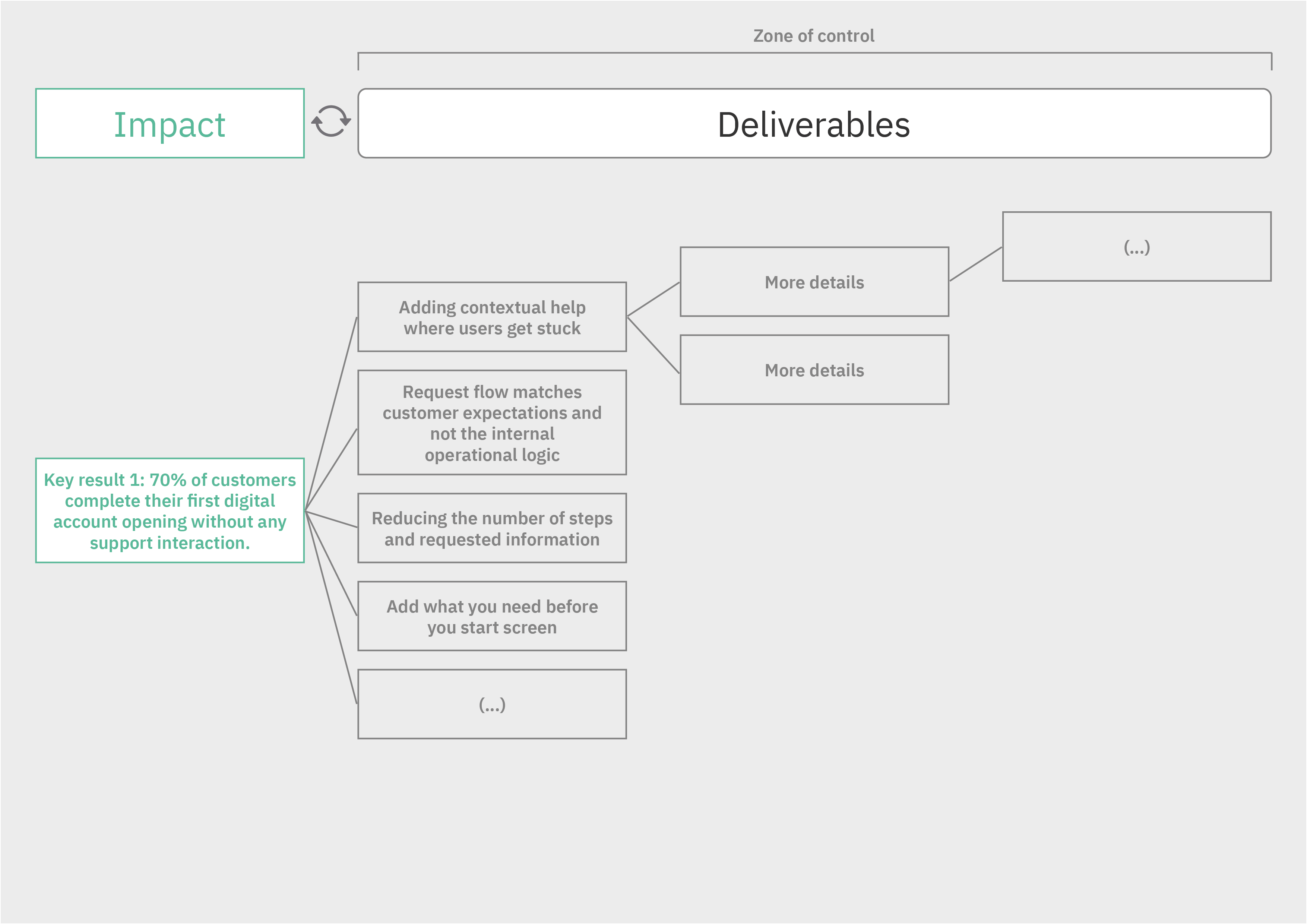
Feel free to adapt the process to your needs. The recommendation is to first create a skeleton for the participants to understand how to map generated ideas and how to do a first validation round to see how an idea will contribute to the desired outcomes (metrics).
The goal is to come up with multiple solution ideas and to explore the pros and cons of the different approaches before you start prioritizing. It is also important to understand the level of confidence and what kind of knowledge (research, discovery work) is missing.
Depending on the level of confidence the selected path could already be turned in a Story Map for implementation or be the starting point for Discovery to fill in missing gaps.
Skeleton
Facilitation
Round 1: Diverge – create options
- Ask for some high level deliverables that can be connected to the outcome metrics (impact) for each actor.
Round 2: Converge – make decisions
- Ask, how this deliverable (feature) will contribute to the impact?
- Ask, if it will impact only this actor or other actors as well
- (Reflect once more how the impact will contribute to achieve the goal)
Find alternatives
There are many Design Thinking techniques you can apply to create new ideas if the group gets stuck. The idea is to create more options before you decide on certain deliverables.
Depending on the complexity of the topic you can also dive deeper and explore small experiments to test key assumptions.
Confidence
Reflect on your confidence level to understand what discovery work is still required?
- What are the key assumptions to test?
- What are the unknowns where we lack information?
- What usability challenges could this solution cause?
- What technical challenges could this solution cause?
Prioritization
You will have generated a lot of ideas for deliverables. Use prioritization techniques to limit yourself to the most promising deliverables.
Continuous monitoring
Impact Mapping is not a one‑time planning exercise. It is a continuous learning loop that connects goals, impacts, and deliverables through measurable outcomes. Monitoring ensures that teams stay aligned, validate assumptions, and adjust direction when reality contradicts expectations.
What to monitor?
- Goal level: Are we moving towards the desired business or user goal?
- Impact level: Are actors changing their behavior as expected? Which impacts are improving, stagnating, or declining?
- Deliverables level: Which deliverables actually influence behavior? Which deliverables have no measurable effect?
Monitoring cadence
- Release cycle: Review metrics based on your release cycle
- Quarterly: Reassess the goal and update the map
References and further reading
- Adzic, Gojko (2012): Impact Mapping. Making a big impact with software products and projects, Surrey: Provoking Thoughts; Website to the book: https://www.impactmapping.org; Additional material: https://github.com/impactmapping/open-impact-mapping-workshop/tree/master/educational-workshops/concerts-online
- Adzic, Gojko (2016): Keynote – Impact Mapping with Innovation Games, vimeo video: https://vimeo.com/195949530 (27.12.2025);
- South Park – Underpants Gnomes (1998). A metaphor for a flawed business logic. YouTube: https://www.youtube.com/watch?v=WpnM37A4P_8, Southpark, Season 2, Episode 17. Directed by Trey Parker, Written by Pam Brady, Trey Parker and Matt Stone
How did you rate this article?
Thank you for your feedback.