Author of this article: Andreas Soller
What is a Product?
This article provides an overview of what a digital product is, how it evolved over time and what product levels can be distinguished. The focus is on the use and core value. Product lifecycles are intentionally excluded as those concepts center around market perspectives rather than value.
7 min read (1638 words)
What is a product?
Use value
Classical economic thought already recognized that goods must provide a certain use value in order to be exchanged. Without usefulness to someone, no exchange could take place. As there is exchange, goods represent also social relationships. While this article will not dive into the history of ideas, I will approach the term product from selected lenses.
I find the concept of use value one of the most fruitful lenses for understanding what a product is. In its most basic form, use value refers to the value any product must deliver to its users to be exchangeable. Consider the example of a car: you might purchase it primarily as a means of transportation. Its use value lies in enabling you to move more quickly and conveniently from one place to another.
But of course, a car is never only about transportation. It may also convey prestige, signal identity, or create a particular emotional or aesthetic experience. Whether it is fuel-powered or electric may be a matter for reasons of sustainability and values.
This is the broader frame in which I will use the term product in this article. Use value is not limited to functional performance. It can include a very broad range of connotations including social and cultural dimensions, desires, experiences, etc.
Product – Service – Experience
For the discussion in this article, we will use product, service and experience interchangeably as the focus is on value creation. I propose to distinguish the terms on the core value creation:
- Product: the core value is a functional capability
- Service: the core value is something that is done for the user or with the user
- Experience: the core value is something the user seeks to experience
Takeaway
Use value means that value is realized in use. But value is not only delivered through what it does (functional), but also through what it represents, enables, signals and how it is experienced.
A product rarely comes alone
Ecosystem
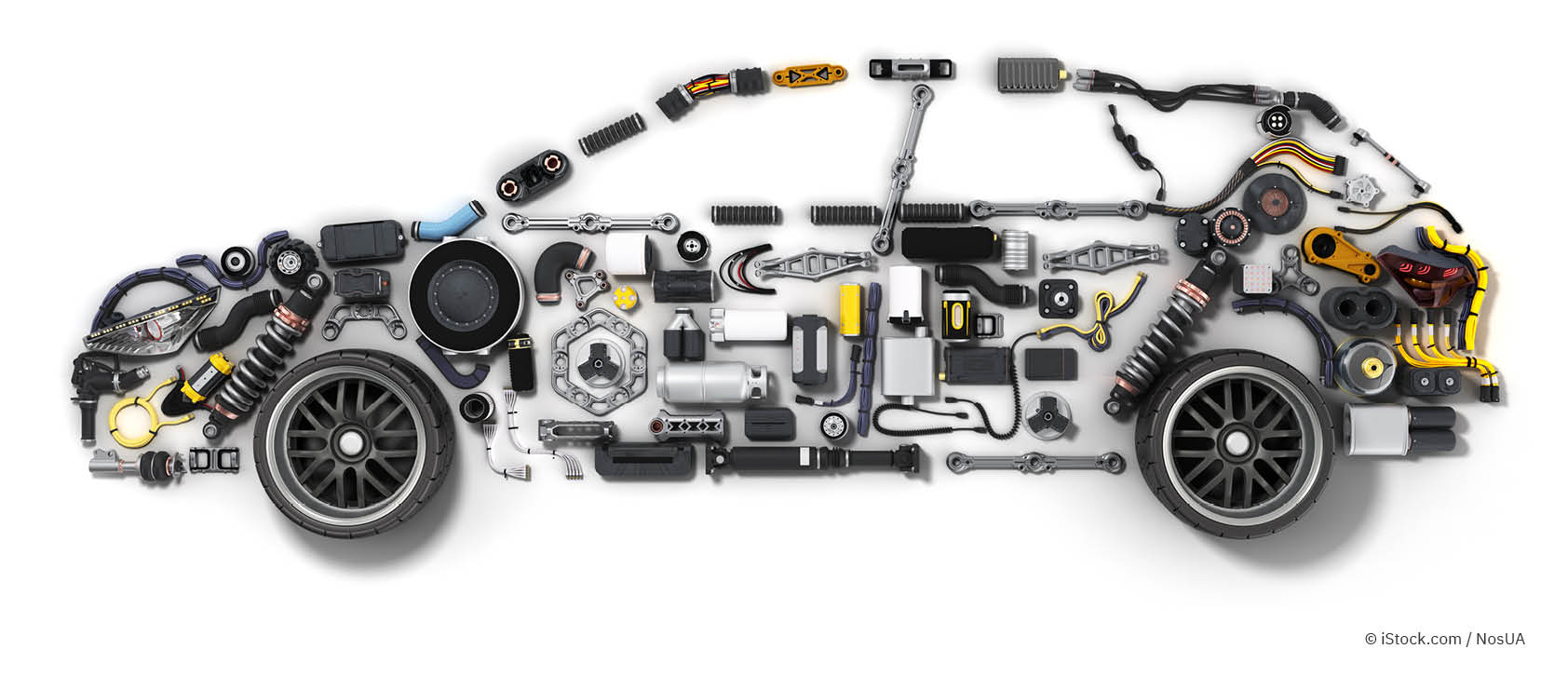
Let us start with a simple tangible product. A car, for example, is more than just a car. It is a system composed of the core mechanical system (engine, transmission, brakes, etc.), safety and comfort features (airbags, seatbelts, climate control, etc.), structural elements (frame, wheels, tank or battery pack), etc.
Each of these parts is a product in itself. Take the airbag: it consists of crash sensors, the folded airbag, a control system, power supply, etc. that are manufactured, branded and exchanged between different companies.
It’s like a Russian doll. With each layer we will again discover more products down to the last screw.
Takeaway
A car is not just a car but the representation of a vast ecosystem of products, suppliers, technologies and (social) relationships.
Brief history of digital products
Digital product
Unlike physical products, digital products are intangible, infinitely replicable, and – as we will see in the brief history – distributed instantly at marginal cost. They evolve continuously, rely on data and algorithms, and can for example generate additional value through network effects.
Distribution via physical media
In the early days (1970s – 1990s) software was shipped as boxed software products on physical media such as magnetic tapes, floppy disks or compact discs, etc. With this dependency on a physical object it was necessary to have a fixed release date where all features were shipped as finished version. The focus of teams was on the delivery date and growth was tied to external distribution channels such as retail stores and the business model was often a one-time purchase.
Digital downloads
From the 1990s until 2000 software was shipped as digital downloads. A user would download the installer software from a website or FTP server. This shift removed physical logistics and it improved update cycles and the possibility to provide patches and updates. The business model was still largely one-time purchase with downloadable upgrades until the next major version.
Online services & platforms
From mid-2000 onward digital products expanded into always‑online services and platforms such as social networks, streaming services, online multiplayer games, marketplaces, app stores, and creator platforms. This shift introduced platform dynamics, network effects, user‑generated content, ecosystem lock‑in, and new business models including advertising, microtransactions, in‑app purchases, platform fees, and creator revenue sharing.
Cloud-based solutions
Post 2010 cloud became the default delivery model for most digital products. Continuous deployment pipelines and subscription models (monthly / annual) became standard practice. With freemium new growth models became possible. Products started embedding growth loop and distribution became part of product usage what allowed rapid scaling.
AI-driven products
With the release of ChatGPT on November 30, 2022, AI was moved from research labs to consumer use. With support of AI, development accelerates and with vibe coding, software can be created with natural language prompts. We might experience products that become adaptive personalized experiences in the near future.
History of digital products
Configure columns
No results found |
Takeaway
Digital products moved from boxed products to cloud‑based services that update continuously and scale through usage. With AI, software is shifting again, and each transition reshapes software creation, distribution, business models, and the way products are used and experienced.
Product levels
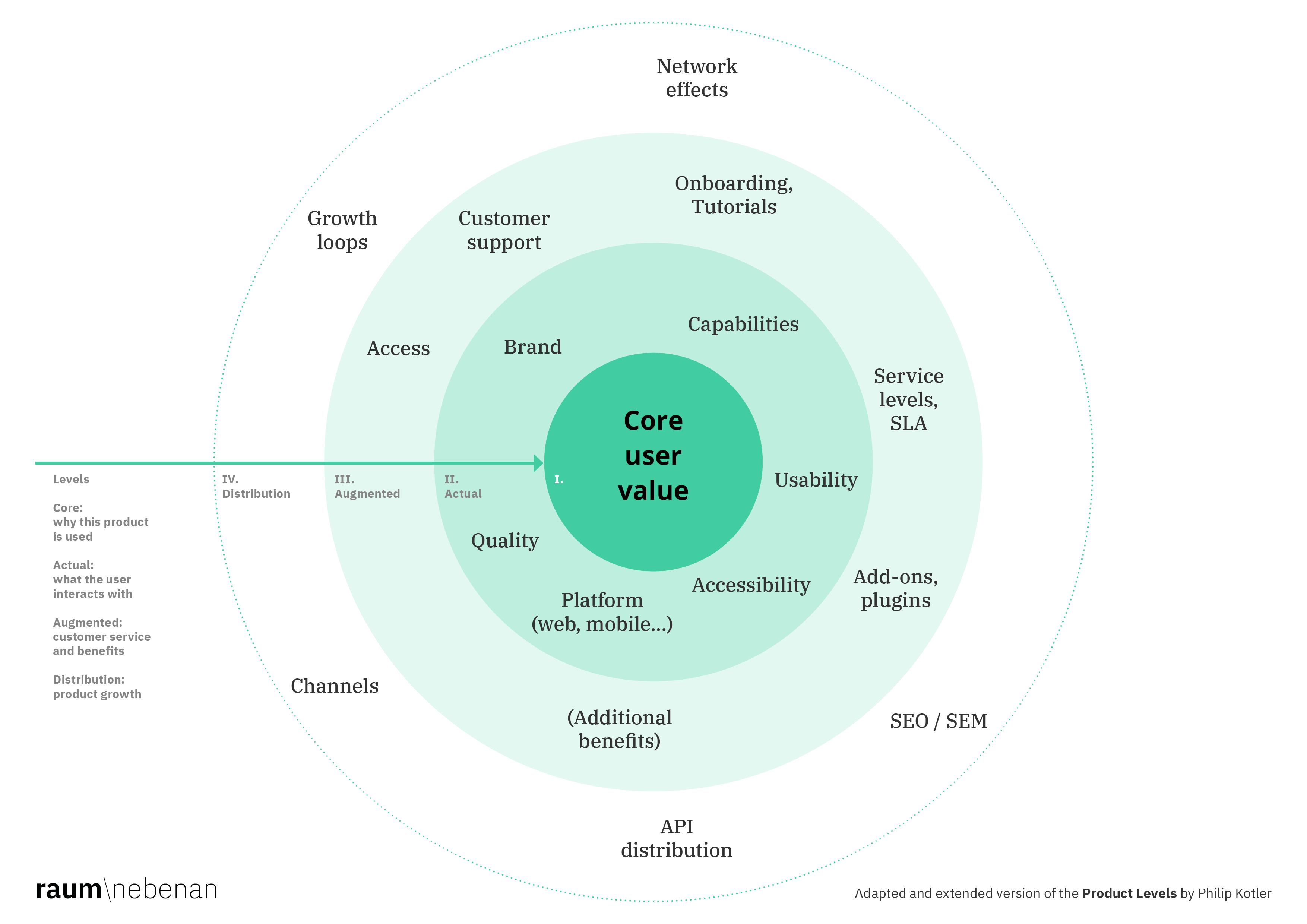
When it comes to value generation, Philip Kotler identifies three levels (cf. Kotler et al 2024:249):
- Core value: The fundamental need, why this product is used. The problem this product solves for the user or the experience the user seeks.
- Actual product: The product itself. This is what the user interacts with in a digital product. The capabilities the product provides.
- Augmented: Everything that surrounds the actual product and enhances the experience or reduces friction such as support or warranty.
As for digital products, distribution can become an essential part of value generation, I added one more level. This is usually expressed with growth loops: A growth loop is a self-reinforcing cycle where each user action creates a potential to create more of a desired outcome that feeds back into the cycle.
Core value
The core value is the outcome the user seeks.
Through the lens of the jobs-to-be-done framework, the core value is the problem the product must solve. (In the framework this is called the job).
At its most fundamental level the user cares what product solves the job best but the user doesn’t care what company provides the solution. The job that needs to get done, is what remains stable over a long period of time. The product (solution) is what changes in time.
Understanding the core value is understanding the minimum outcome the product must deliver to its user. Outcome can also be an experience the user seeks.
Takeaway
Use value is the broad category of value realized in use; core value is the specific outcome a product must deliver to fulfill its use value.
Actual product
Capabilities
The core value doesn’t come alone and is embedded in a set of capabilities a certain product offers.
With the spreadsheet application Microsoft Excel you can perform calculations, analyze data in form of Pivot Tables or visualize data among many other features. Each feature enables the user to achieve a specific job. Features provide specific product capabilities for its users.
While Microsoft Word or Microsoft Excel can be used and bought independently, they are also bundled together as Microsoft Office. Such a software bundle can be referred to as product portfolio. Depending on your business you might also have a portfolio of product bundles. (This is usually the case when the bundles themselves have a value proposition.)
Other aspects
- Brand: brands and products are increasingly fused. The product carries the brand experience.
- Usability: Learnability, efficiency, effectiveness, memorability, error tolerance…
- Accessibility: how accessible the product is for people with diverse abilities
Augmented product
The augmented product includes all the additional elements that surround the actual product and enhance the user’s experience beyond the core functionality. These elements reduce friction, increase perceived value, and help to further differentiate the product in competitive markets.
- Support and service (help centers, onboarding)
- Guarantees, warranties
- Regulatory topics
- Documentation
- Service Level Agreements (SLAs)
- Add-ons, plugins
- etc.
Distribution
Product growth and network effects
When distribution becomes part of the product, then usage accelerates value generation. Think about a user generated content loop where the content one user generates can be used by other users. Whenever users create value, it not only helps them, but contributes to the overall usage of product.
Every action inside the product can create new users, new content, or new transactions. So, distribution itself becomes a value-creating mechanism embedded in the product experience.
Takeaway
Value in digital products is created through the core need they solve, the actual product users interact with, the augmented services that enhance the experience, and the distribution systems that drive not access and scale but increase additionally the benefits of using the product.
References and further reading
- Kalbach, Jim (2020): The Jobs to be done Playbook. Align your Markets, Organizations, and Strategy around Customer Needs. New York: Two Waves;
- Kotler, Philip; Armstrong, Gary; Balasubramanian, Sridhar (2024): Principles of Marketing, 19. edition, Harlow: Pearson Education Limited
How did you rate this article?
Thank you for your feedback.